
Most ecommerce teams judge Google Search ads by keyword. "Exact match" keywords are the safe, high-intent ones, so they usually get the most budget.
But since AI Max for Search arrived, Google can show your ad for searches it thinks match your intent, even on an exact match keyword. Until now, the tracking codes in your ad links could not tell you when that happened. A click from an AI Max match could reach your site labelled "exact", just like a real exact match click.
That has now changed. On 11 November 2026, PPC News Feed reported a new Google Ads tracking code called {search_term_matchtype}, spotted by Hana Kobzová. Search Engine Land covered it the same day, and PPC Land went into detail on 15 November 2026.
For ecommerce and digital directors, the lesson is short: some clicks your reports call "exact match" were really found by AI Max. Tag them in the click link, then judge AI Max on your own orders, not on Google's labels.
What Google changed
Google Ads uses small codes called ValueTrack parameters. You add them to your ad links, and Google fills them in at the moment of the click. Your analytics, shop platform or CRM can then read them from the page address.
Google's help page "Set up tracking with ValueTrack parameters" now lists a new one. It describes {search_term_matchtype} as:
"The match type of the search term that triggered your ad: "e" for exact, "p" for phrase, "b" for broad, or "a" for AI Max broad expansions and keywordless matches."
In plain words, here is what the sources say:
- The old code could hide AI Max. The older {matchtype} code reports the match type of your keyword. PPC Land explains that when AI Max expands an exact match keyword, the old code still says "e", so "a click marked "exact" may in fact have been an AI Max expansion".
- The new code reports how the search really matched. Google's "How you can use ValueTrack" page says the search term match type "can differ from the keyword's match type, especially with broad match". A value of "a" means AI Max found the search.
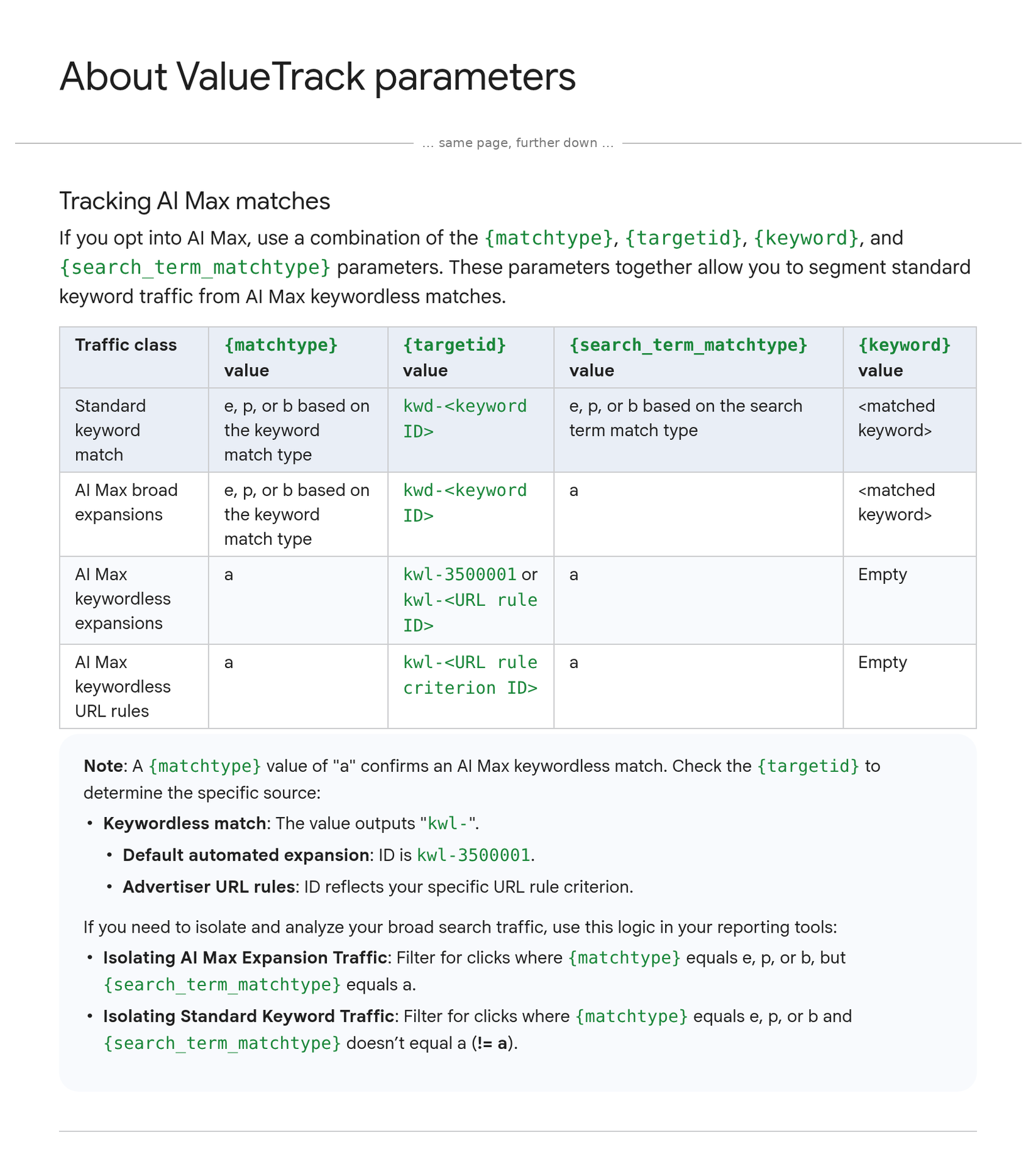
- Google gives a recipe. Its "About ValueTrack parameters" page has a section called "Tracking AI Max matches". It says that using {matchtype}, {targetid}, {keyword} and {search_term_matchtype} together will "segment standard keyword traffic from AI Max keywordless matches". It tells you to isolate AI Max expansion traffic by filtering "for clicks where {matchtype} equals e, p, or b, but {search_term_matchtype} equals a".
- It does not change your ads. PPC Land says the code "does not change how AI Max matches queries, how Google bids or what advertisers pay". It only changes what you can measure.
- Some things are not clear yet. PPC Land says Google gives no date for the change and links to no announcement. Google's Performance Max table does not list the new code, so treat it as a Search campaign tool for now.
Sources: Google Ads Help — About ValueTrack parameters; Google Ads Help — Set up tracking with ValueTrack parameters; Google Ads Help — How you can use ValueTrack; PPC News Feed, 11 November 2026; Search Engine Land, Anu Adegbola, 11 November 2026; PPC Land, Luis Rijo, 15 November 2026.
What it means, in plain terms
AI Max is not a small corner of your account any more. PPC Land reports that Search campaigns using the campaign-level broad match setting or automatically created assets began moving to AI Max from 1 September 2026, with Dynamic Search Ads campaigns due to follow in February 2027.
PPC Land also points to an analysis by Mike Ryan of Smarter Ecommerce. Across 383 million EMEA ecommerce Search impressions with AI Max switched on, the share of exact match keyword impressions served through AI Max expansions rose from about zero in January 2025 to nearly 29% by July 2026.
Three things matter for your P&L:
- Your best keywords may look better than they are. If part of your "exact match" sales really came from AI Max, your exact match figures are carrying traffic they did not win. Budget decisions based on them can be wrong in both directions.
- You can't judge AI Max on Google's word alone. Google Ads has AI Max reports, but they stay inside Google Ads. A label in the click link travels with the visit into GA4, and from there it can be tied to real orders and margin in your own systems.
- A label is not proof of profit. Search Engine Land makes the key point: the new code "doesn't automatically measure the incremental value of AI Max". It tells you where a click came from. It does not tell you if you would have made that sale anyway.
There is a timing point too. Black Friday is on 27 November. If AI Max traffic is going to spike, peak week is when you most want to see it clearly, and when a broken ad link costs the most.
The director checklist
- Ask if you use AI Max. Ask your team or agency which Search campaigns have AI Max switched on, including any that were upgraded automatically from September.
- Add the label to your ad links. Google's example tracking template is
{lpurl}?keyword={keyword}&matchtype={matchtype}&search_term_matchtype={search_term_matchtype}&targetid={targetid}. Keep {lpurl} at the start. Google warns that without a final URL code like it, "your landing page URL will break". - Test before you save. Use the Test button in Google Ads, then click through to a live product page. Check the page loads, the label appears in the address, and auto-tagging still works.
- Keep the label with the visit and the order. Ask your team to save the label in GA4 as a custom dimension and, if you can, pass it to your shop platform or CRM with each order. A label only on the first page view is easy to lose.
- Report three groups, not one. Standard keyword clicks, AI Max expansions on your keywords, and AI Max keywordless clicks. Use Google's filter rules so the groups don't overlap.
- Judge AI Max on your own orders. Compare each group on orders, revenue, returns and margin from your own systems, not just on Google Ads conversions.
- Decide after peak, not during it. Gather the data through Black Friday and Cyber Monday. Make AI Max budget calls in December, with a proper test if the numbers are big.
Related reading: Google’s lift test can’t read sales that come from GA4 and Two £100 orders can leave very different profit.
Not sure what your ad clicks are really worth?
Run our free tracking scan at audit.taggurus.co.uk for a quick health score on your GA4 and Google Ads tracking.
Want a senior second opinion before Black Friday? Email info@taggurus.co.uk or book a meeting today to discuss.
#36/100 in our series “100 important things to know in the digital world”.
FAQ
Q: What is AI Max for Search?
A: It is a Google Ads setting for Search campaigns. It lets Google show your ads for searches it thinks match your intent, beyond your exact keywords, and can also change ad text and landing pages.
Q: Will adding this tracking code change my ads or what I pay?
A: No. PPC Land says it "does not change how AI Max matches queries, how Google bids or what advertisers pay". Search Engine Land adds that it brings no new bidding or targeting controls. It only adds a label to the click link.
Q: Can't I just use Google Ads reports?
A: Google Ads does report AI Max matches. But those reports stay inside Google Ads. A label in the click link lets you check AI Max against your own orders, returns and margin.
Q: Does it work for Performance Max?
A: The sources don't say it does. PPC Land notes that Google's Performance Max table does not list the new code. Treat it as a Search campaign tool for now.
Q: If AI Max clicks look weaker, should we turn AI Max off?
A: Not straight away, and not in peak week. A label shows where a click came from, not whether you would have won the sale anyway. Gather the data, then test properly in December.
Sources
- https://support.google.com/google-ads/answer/2375447?hl=en (Google Ads Help, “About ValueTrack parameters”, read 18 November 2026: section “Tracking AI Max matches”: “If you opt into AI Max, use a combination of the {matchtype}, {targetid}, {keyword}, and {search_term_matchtype} parameters. These parameters together allow you to segment standard keyword traffic from AI Max keywordless matches.”; traffic class table; filter rules for AI Max expansion and standard keyword traffic)
- https://support.google.com/google-ads/answer/6305348?hl=en (Google Ads Help, “Set up tracking with ValueTrack parameters”, read 18 November 2026: {search_term_matchtype} “The match type of the search term that triggered your ad: "e" for exact, "p" for phrase, "b" for broad, or "a" for AI Max broad expansions and keywordless matches.”; {matchtype} “a” for “AI Max keywordless”; “If you don’t include a URL insertion parameter in your tracking template, your landing page URL will break.”)
- https://support.google.com/google-ads/answer/6305529?hl=en (Google Ads Help, “How you can use ValueTrack”, read 18 November 2026: search term match type “can differ from the keyword's match type, especially with broad match”; example template with {targetid}; example URLs for keyword, AI Max broad expansion and AI Max keywordless traffic)
- https://ppcnewsfeed.com/ppc-news/2026-11/new-value-track-parameter-isolates-ai-max-traffic/ (PPC News Feed, 11 November 2026: new {search_term_matchtype} parameter; spotted by Hana Kobzová)
- https://searchengineland.com/google-ads-introduces-new-valuetrack-parameter-to-identify-ai-max-traffic-501420 (Search Engine Land, Anu Adegbola, 11 November 2026: the parameter “doesn’t automatically measure the incremental value of AI Max”; no new bidding or targeting controls)
- https://ppc.land/googles-new-parameter-shows-when-an-exact-click-was-really-ai-max/ (PPC Land, Luis Rijo, 15 November 2026: {matchtype} labels AI Max broad expansions with the keyword’s match type, so “a click marked "exact" may in fact have been an AI Max expansion”; Smarter Ecommerce analysis: nearly 29% of exact match keyword impressions served through AI Max expansions by July 2026 across 383 million EMEA ecommerce Search impressions; AI Max upgrades from 1 September 2026, Dynamic Search Ads from February 2027; no date given by Google; not in the Performance Max table; “does not change how AI Max matches queries, how Google bids or what advertisers pay”)
