
Meta is changing how its Pixel counts website sales, and the change is switched on unless you switch it off.
The setting is called Measure conversions on customer devices. It lets Meta match an ad view to a purchase on the shopper’s own phone or laptop, instead of only on Meta’s servers. Meta says this lets it count sales it currently misses. Meta’s notice to advertisers, as reported by PPC Land and others, gives the start date as 12 November 2026. That is 15 days before Black Friday.
On 26 October, Yiqi Wu, chief executive of Shopify tracking company Aimerce, who lists ten years of engineering work at Meta, Instagram and Reddit, put it bluntly on X: Meta “will start counting more conversions starting November 12, 2026.”
For ecommerce and digital directors, the lesson is short: if Meta’s sales jump in mid-November, check your own orders before you move budget. The counting may have changed, not the customers.
What Meta says
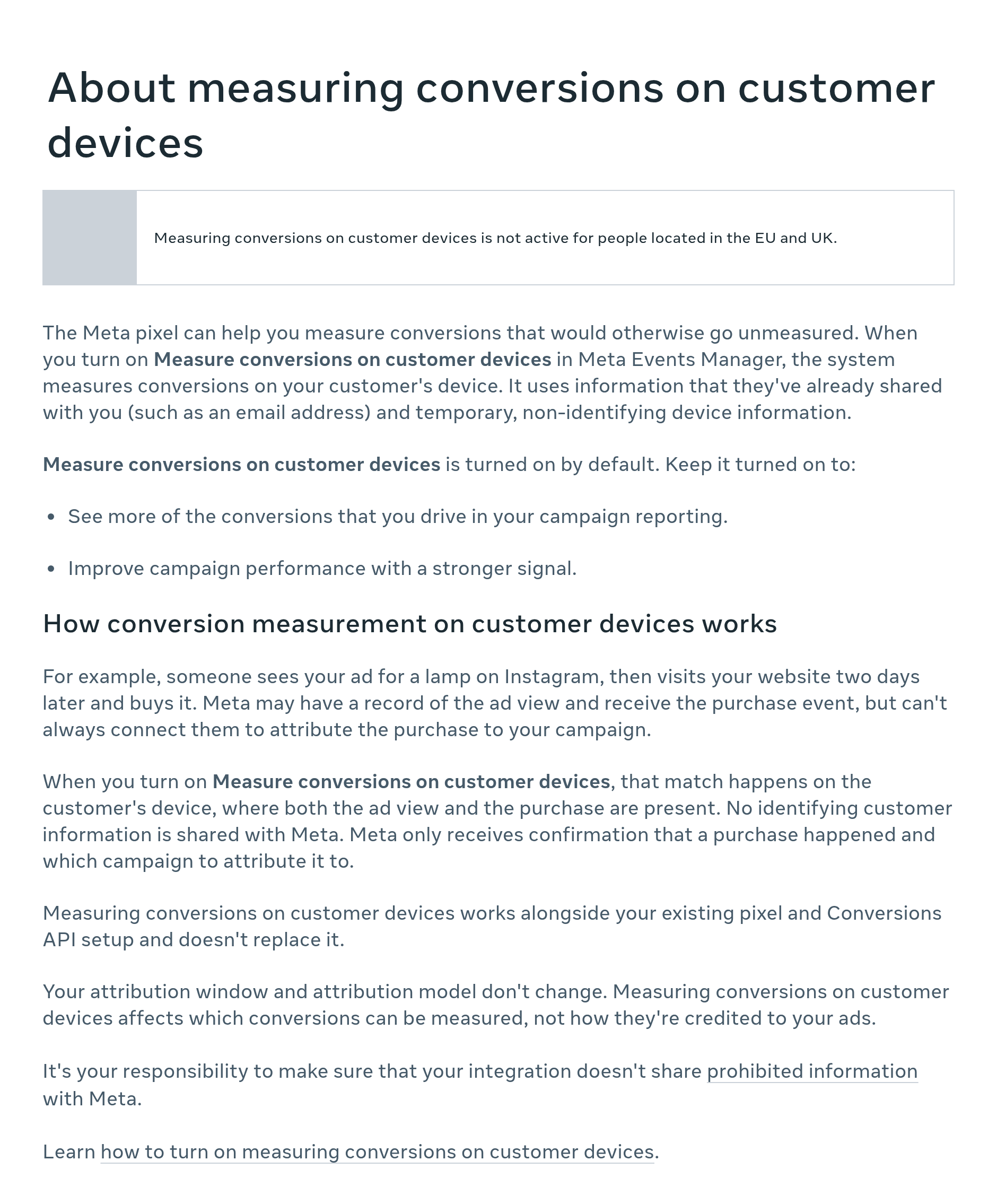
Meta’s Business Help Centre page, “About measuring conversions on customer devices”, sets out the basics:
“Measuring conversions on customer devices is not active for people located in the EU and UK.”
“Measure conversions on customer devices is turned on by default.”
Meta says the match uses information the shopper has “already shared with you (such as an email address) and temporary, non-identifying device information”, and that “Meta only receives confirmation that a purchase happened and which campaign to attribute it to.”
It also says the feature “works alongside your existing pixel and Conversions API setup and doesn’t replace it”, and: “Your attribution window and attribution model don’t change. Measuring conversions on customer devices affects which conversions can be measured, not how they’re credited to your ads.”
Meta’s reasons to keep it on are two lines: “See more of the conversions that you drive in your campaign reporting” and “Improve campaign performance with a stronger signal.”
A second Meta page, on how to turn it on, adds two conditions. The Pixel must be installed “directly on your page, not inside an iframe or as an image-only (img) pixel”, and “Your website must require people to log in to an account using an email or mobile phone number.” The switch sits in Events Manager, under Data sources, your pixel, then Settings.
Sources: Meta Business Help Centre — About measuring conversions on customer devices and How to turn on measuring conversions on customer devices (both checked 27 October 2026).
What it means, in plain terms
Today, when someone buys on your site, the Meta Pixel sends the sale to Meta. Meta then tries to link it to someone who saw or clicked an ad. Often it cannot: cookies are blocked, links are stripped, or the visit came days later on a different path. Those sales happen, but Meta’s reports never show them against an ad.
The new setting tries to make that link on the shopper’s device, where both the ad view and the purchase can be seen. If it works, more of your existing sales get credited to Meta campaigns.
- Same sales, more credit. Your shop does not take more money because of this setting. Meta’s report may simply show more of the sales you already had.
- Same rules. Meta says the attribution window and model do not change. So the jump will look like normal performance unless someone labels it.
- Not for UK and EU shoppers. Meta says the feature is not active for people located in the EU and UK. If you only sell in the UK, you may see little change. If you sell to the US, Australia or other markets, those shoppers can be counted differently from 12 November.
What is not clear yet
Meta’s public pages leave some big questions open. Several practitioners have listed them, including PPC Land, Stape and MetricMaven:
- Bidding. Meta’s page says “stronger signal”, which suggests the extra sales may feed delivery. It does not say how, or whether sale values are included in ROAS.
- Double counting. Meta does not explain how a sale matched on the device is kept apart from the same sale sent by the Conversions API.
- Which sites qualify. Read literally, the login condition could leave out shops where people can check out as guests. Meta has not explained it further.
- Consent. Meta’s pages do not say how cookie banner choices or opt-out signals are handled. For UK and EU shoppers it is switched off anyway.
- The date. 12 November comes from Meta’s notice and the label in Events Manager, as reported by PPC Land, Stape and MetricMaven. Meta’s help page does not repeat the date, and the rollout is reported to be gradual.
Sources: PPC Land — Meta Pixel will count more conversions from Nov 12 unless advertisers opt out (27 October 2026); Stape — Meta on-device conversion measurement (22 October 2026); MetricMaven — Meta’s on-device conversion setting starts November 12 (19 October 2026).
Why it matters for the P&L
- Budget follows the best-looking number. If Meta’s ROAS rises in the second half of November, the easy move is to give Meta more money. If the rise is only better counting, that money buys nothing extra.
- It lands in your most expensive weeks. Black Friday is 27 November. A counting change on 12 November will blur every “this year versus last year” comparison for peak.
- Channels will add up to more than you sold. Google Ads, Meta and GA4 already disagree. More Meta credit for the same orders makes the total of all platforms drift further from your real sales.
- Your own orders are the referee. The only number this setting cannot change is the order count in Shopify, Magento or your finance system.
This links to two earlier notes. Recovered conversions are sales you already had made the same point about Google Ads. Safari 27 and email-based tracking showed how browsers are closing the email routes many tags rely on. Meta’s new setting also uses the shopper’s email, on the device, and Meta has not said how it works in Safari.
Director checklist
- Find out where your Meta sales come from. Ask what share of Meta-driven orders comes from shoppers outside the UK and EU. That is the part of your business this setting can touch.
- Check the switch on every pixel. In Events Manager, go to Data sources, your pixel, then Settings, and look for “Measure conversions on customer devices”. Write down whether it is on or off, who checked and when.
- Decide on purpose. Leaving it on is a choice, not a default. If you trade in health, finance or other sensitive areas, ask your privacy lead before 12 November.
- Take a baseline now. Export Meta-reported purchases and purchase value by day for the last four weeks. Put them next to your own paid orders for the same days. Work out the ratio.
- Mark 12 November on every report. Add a note to dashboards and board slides that use Meta numbers, so nobody reads the jump as a win.
- Keep the plumbing steady. Keep the Conversions API or server-side tracking running. Do not change how you send customer data to Meta close to 12 November, or you will not know which change did what.
- Judge it on your own orders. After 12 November, watch the ratio for four to six weeks. If Meta’s share of orders rises but your orders do not, it is counting, not growth. Test real impact with a holdout after peak.
Questions to ask your team this week
- Is the new setting on or off on each of our pixels, and who decided?
- How many of our Meta-driven orders come from outside the UK and EU?
- Do we have a daily baseline of Meta purchases next to our own orders?
- Does our site meet Meta’s login condition, or do most people check out as guests?
- Which reports and bonuses use Meta ROAS, and who will flag the 12 November change?
Caveats
- One Meta page, many reports. Meta’s help pages are short. The start date and some details come from Meta’s notice to advertisers, as reported by PPC Land, Stape and MetricMaven, plus Yiqi Wu’s post on X.
- A tracking vendor’s view. Yiqi Wu’s company sells Pixel tracking to Shopify brands, so it has a commercial interest. The advice to compare Meta with real orders is sound either way.
- UK impact may be small. Meta says the feature is not active for people in the EU and UK. Do not assume a UK-only shop will see a jump. Do not assume an international shop will not.
- Your books win. Meta’s report is an estimate of what its ads touched. Your order system is still the source of truth.
Final thoughts
#23/100 — If Meta’s sales jump after 12 November, check your own orders first. The counting may have changed, not the customers.
More credit for Meta is not the same as more sales for you. Take a baseline now, label the change, and judge Meta on your own orders through peak.
Not sure what your Meta Pixel and Conversions API are really sending? Run our free GA4 and GTM tracking scan at https://audit.taggurus.co.uk/, email info@taggurus.co.uk, or book a meeting today to discuss.
FAQ
Q: What is “Measure conversions on customer devices”?
A: A new Meta Pixel setting in Events Manager. It lets Meta match an ad view to a website purchase on the shopper’s own device, so it can credit some sales it could not link to an ad before. Meta says it only receives confirmation that a purchase happened and which campaign gets credit.
Q: Is it on by default?
A: Yes. Meta’s help page says it “is turned on by default”, and the setup page says it is on by default for eligible pixels. You can turn it off at any time in Events Manager, under Data sources, your pixel, then Settings.
Q: Does it affect UK shoppers?
A: Meta says it “is not active for people located in the EU and UK.” UK retailers selling to the US or other markets outside the EU can still see changes for those shoppers.
Q: Will our sales go up?
A: Not because of this setting. It changes what Meta can count, not what customers buy. Meta’s reported purchases, cost per purchase and ROAS may move while your real orders stay the same.
Q: Should we turn it off?
A: There is no single answer. Many teams will leave it on and watch it closely. Turn it off, and write down why, if you cannot get a clean baseline, if your privacy lead has concerns, or if Meta’s numbers stop matching your orders and nobody can explain why.
Q: Does it replace the Conversions API?
A: No. Meta says it works alongside the Pixel and Conversions API and does not replace them. Keep your server-side tracking running.
Sources
- https://www.facebook.com/business/help/4237575203200036 (Meta Business Help Centre, “About measuring conversions on customer devices”, checked 27 October 2026: “Measuring conversions on customer devices is not active for people located in the EU and UK”; “turned on by default”; uses information shoppers “already shared with you (such as an email address) and temporary, non-identifying device information”; “Meta only receives confirmation that a purchase happened and which campaign to attribute it to”; works alongside the Pixel and Conversions API; “Your attribution window and attribution model don’t change”)
- https://www.facebook.com/business/help/2192875204996675 (Meta Business Help Centre, “How to turn on measuring conversions on customer devices”, checked 27 October 2026: Pixel installed directly on the page, not in an iframe or as an image-only pixel; website must require people to log in with an email or mobile phone number; Events Manager > Data sources > pixel > Settings; “on by default for eligible pixels”)
- https://x.com/yiqiw_/status/2114764745249100256 (Yiqi Wu, chief executive of Aimerce, X, 26 October 2026, 5:03pm UK time: “Meta will start counting more conversions starting November 12, 2026”; advice to export Meta-attributed purchases next to Shopify paid orders by day, track the ratio, and keep server-side tracking/CAPI active)
- https://ppc.land/meta-pixel-will-count-more-conversions-from-nov-12-unless-advertisers-opt-out/ (PPC Land, Luis Rijo, 27 October 2026: Events Manager label “Measurement starting November 12, 2026”; notice reported by Wortfilter and ASTIG on 18 October; open questions on bidding, purchase value and consent; 12 November is 15 days before Black Friday)
- https://stape.io/news/meta-on-device-conversion-measurement (Stape, 22 October 2026: rollout on 12 November 2026; reported CPA and ROAS may improve “even if actual sales and advertising spend remain the same”; Meta does not explain how on-device matches interact with server events)
- https://www.metricmaven.io/blog/meta-measure-conversions-on-customer-devices (MetricMaven, Jamie Isabel, 19 October 2026: take a baseline before 12 November, track platform-to-backend ratio, run a holdout; four questions to ask Meta in writing)
