
When a shopper clicks "reject" on your cookie banner, Google's tags still send some data to Google. Consent mode decides what goes and what stays behind.
Many retailers, agencies and cookie banner tools have explained this to shoppers using Google's own help page, the Consent mode reference. For years that page said two reassuring things about IP addresses (the number that points to a shopper's internet connection): that Google Ads shortens (truncates) IP addresses when advertising consent is refused, and that Google Analytics does not store or log them.
Those lines are now gone. The PPC Times spotted the change on 25 November 2026. Google has not said why, or whether anything has changed behind the scenes.
For ecommerce and digital directors, the lesson is short: Google's consent help page no longer says what happens to visitor IP addresses when shoppers say no. If your privacy notice quotes those lines, check it against Google's current pages and ask Google for a clear answer.
What Google published
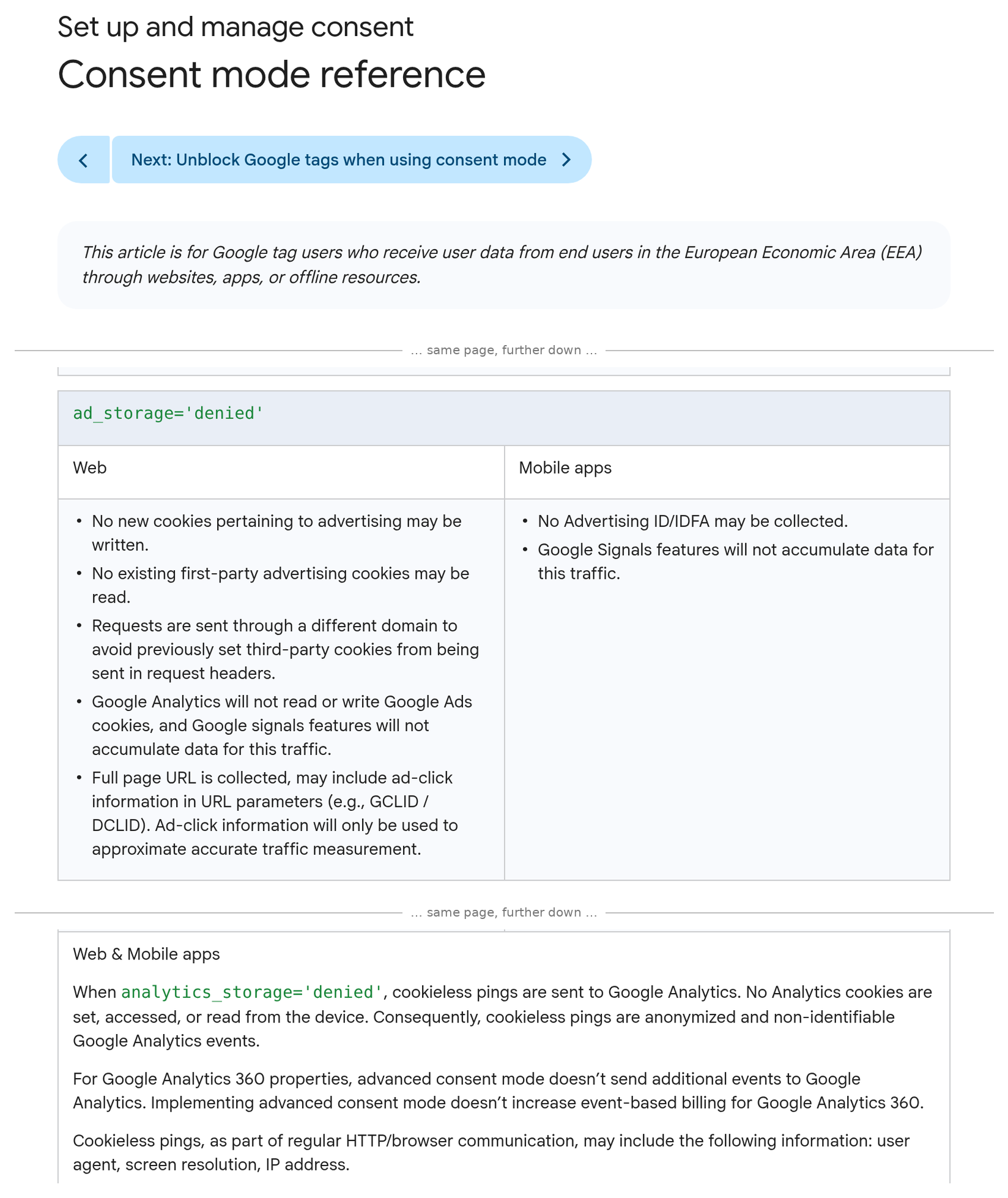
Google's "Consent mode reference" page is written for "Google tag users who receive user data from end users in the European Economic Area (EEA)". It lists how Google tags behave for each consent choice.
Here is what changed, in plain words:
- The Google Ads line is gone. An October 2026 copy of the page said "Ads products truncate IP addresses at collection" when advertising consent (ad_storage) is refused. Today's page has no such line, for websites or apps.
- The Google Analytics note is gone. The page still says that when analytics consent is refused, the data sent to Google "may include the following information: user agent, screen resolution, IP address." The sentence that followed, "Note that Google Analytics does not store or log IP addresses", has been removed.
- The rest reads as before. With advertising consent refused, no new advertising cookies are written and existing ones are not read.
- Other Google pages still say it. Google's developer guide to consent mode still says "Ads products truncate IP addresses at collection". Google Analytics Help still says it "does not log or store IP addresses from EU, Switzerland, or UK users."
What Google does not say: why the lines were removed, or whether the way it handles IP addresses has changed. So treat this as a change in what Google promises in writing, not proof of a change in what it does.
Sources: Google Ads Help — Consent mode reference; The PPC Times, Thomas Eccel, 25 November 2026.
What it means, in plain terms
This is not a tracking problem. Your tags, your reports and your Black Friday numbers are not affected by a help page edit. It is a paperwork and trust problem, and those land on the P&L in other ways.
Three things matter:
- Your privacy notice may now say more than Google does. If your cookie notice tells shoppers that "Google truncates your IP address" and points to Google's page as proof, that proof has gone. A promise you cannot back up is a risk for your legal team, not your marketing team.
- Your paperwork may be out of date. Data protection impact assessments, records of processing and agency hand-over notes often copy Google's wording. Anything that quoted the removed lines now quotes text Google no longer publishes on that page.
- Google's pages now disagree. One Google page dropped the lines; another still has them. Until Google clears this up, the safest move is to quote what you can check today and keep a dated copy.
There is good news for peak week: none of this needs a code change. You do not need to touch your cookie banner or your tags during your Black Friday freeze. It is a document check your team can do in an hour.
This sits next to an earlier change. From 11 January 2027, Google's ad tags in a server-side Tag Manager container can see the full visitor IP by default. Read Server-side GTM will pass full IP addresses to Google Ads tags.
The director checklist
- Search your own words. Look through your privacy policy, cookie notice and banner text for "IP", "truncate", "anonymise" and "does not store". Note every place that describes what Google does.
- Check each line against today's pages. For each statement, find the Google page it relies on and read the current version. If the wording has gone, flag it.
- Keep a dated copy. Save today's version of the Consent mode reference and any page you quote. Help pages change without notice.
- Ask Google in writing. Ask your Google contact how IP addresses are handled today when shoppers refuse consent. Keep the answer with your records.
- Let legal decide the wording. Hand the list to your legal or privacy lead. They decide what to change and when. We do not give legal advice.
- Don't touch the banner in peak week. If changes are needed, plan them for December, test them, and check your consent rates before and after.
Related reading: Consent mode defaults: what ecommerce directors should check.
Not sure what your consent setup really sends?
Run our free tracking scan at audit.taggurus.co.uk for a quick health score on your GA4, Google Ads and consent tracking.
Want a senior second opinion after Black Friday? Email info@taggurus.co.uk or book a meeting today to discuss.
#43/100 in our series “100 important things to know in the digital world”.
FAQ
Q: What did Google remove from the Consent mode reference page?
A: The line "Ads products truncate IP addresses at collection" for traffic where advertising consent is refused, and the note "Google Analytics does not store or log IP addresses" after the cookieless pings line.
Q: Has Google changed how it handles IP addresses?
A: Google has not said. The page does not explain the change. Treat it as a change in Google's written wording, and ask Google directly if your notices depend on it.
Q: Do we need to change our tags or cookie banner?
A: Not because of this edit. Tags behave as they did yesterday. The check is on your privacy notice and internal documents.
Q: Does Google still say this anywhere?
A: Yes. On 27 November 2026, Google's developer guide to consent mode still said Ads products truncate IP addresses at collection, and Google Analytics Help still said it does not log or store IP addresses from EU, Switzerland or UK users.
Q: Is this a UK issue?
A: The page is written for users in the European Economic Area. UK retailers often use the same consent setup and the same wording, so it is worth the same check.
Sources
- https://support.google.com/google-ads/answer/13802165?hl=en (Google Ads Help, “Consent mode reference”, read 27 November 2026: written for “Google tag users who receive user data from end users in the European Economic Area (EEA)”; ad_storage='denied' Web and Mobile apps lists have no IP truncation line; analytics_storage='denied': cookieless pings “may include the following information: user agent, screen resolution, IP address.” with no following note; same text on the Analytics Help copy https://support.google.com/analytics/answer/13802165?hl=en)
- https://web.archive.org/web/20261003133000/https://support.google.com/google-ads/answer/13802165 (Internet Archive copy of the same page, 3 October 2026: “Ads products truncate IP addresses at collection” appears three times; “Note that Google Analytics does not store or log IP addresses.”)
- https://ppctimes.com/news/google-ads-consent-mode-ip-truncation-lines-removed (The PPC Times, Thomas Eccel, 25 November 2026: four IP address lines removed, change detected 25 November 2026; the page does not say why or whether handling changed)
- https://developers.google.com/tag-platform/security/concepts/consent-mode (Google for Developers, “Consent mode overview”, read 27 November 2026: “Ads products truncate IP addresses at collection.”)
- https://support.google.com/analytics/answer/12017362?hl=en (Google Analytics Help, “EU, Switzerland, or UK-focused data and privacy”, read 27 November 2026: “Google Analytics does not log or store IP addresses from EU, Switzerland, or UK users.”)
