
Many retailers tell Google Ads that a new customer is worth more than a repeat one. Until now, that extra worth was a fixed amount, such as £20 added to every first order. From this month, it can also be a multiplier: up to five times the order value.
Google announced the change on 22 October 2026. It is a sensible fix for a real problem. But it also means the “conversion value” in your Google Ads reports can drift further away from what customers actually paid you.
For ecommerce and digital directors, the lesson is short: before anyone switches it on, know where to see the real sale value, make sure your own system tells Google who is new, and judge results on your own orders.
What Google announced
On 22 October 2026, Google’s official ads liaison account on X (AdsLiaison) posted a three-part thread. It opened:
“Retailers: You’re no longer limited to flat-rate bidding adjustments for customer acquisition & retention in Google Ads.”
It explained the problem with a flat bonus: “A static $20 incremental conversion value set on a small $50 checkout might be too aggressive, but not aggressive enough on a large $1,000 cart.”
The second post gave the detail. With the new “Multiply by” option, bids “can scale dynamically with predicted cart size (from 1.1x up to 5x)”. Its example: at 1.2x, “A $100 purchase value dynamically scales to $120” and “A $500 purchase value dynamically scales to $600.” It said the multipliers are “rolling out globally this month across Search, Shopping, Performance Max, and Demand Gen in both Google Ads and SA360.”
The third post added two more changes:
- High value mode for new customers is rolling out in Shopping campaigns.
- Three retention modes (Re-engagement, Loyalty and Retention-only) are rolling out in Performance Max, Search and Shopping, to reach existing customers.
Source: AdsLiaison on X, 22 October 2026 (checked 23 October 2026).
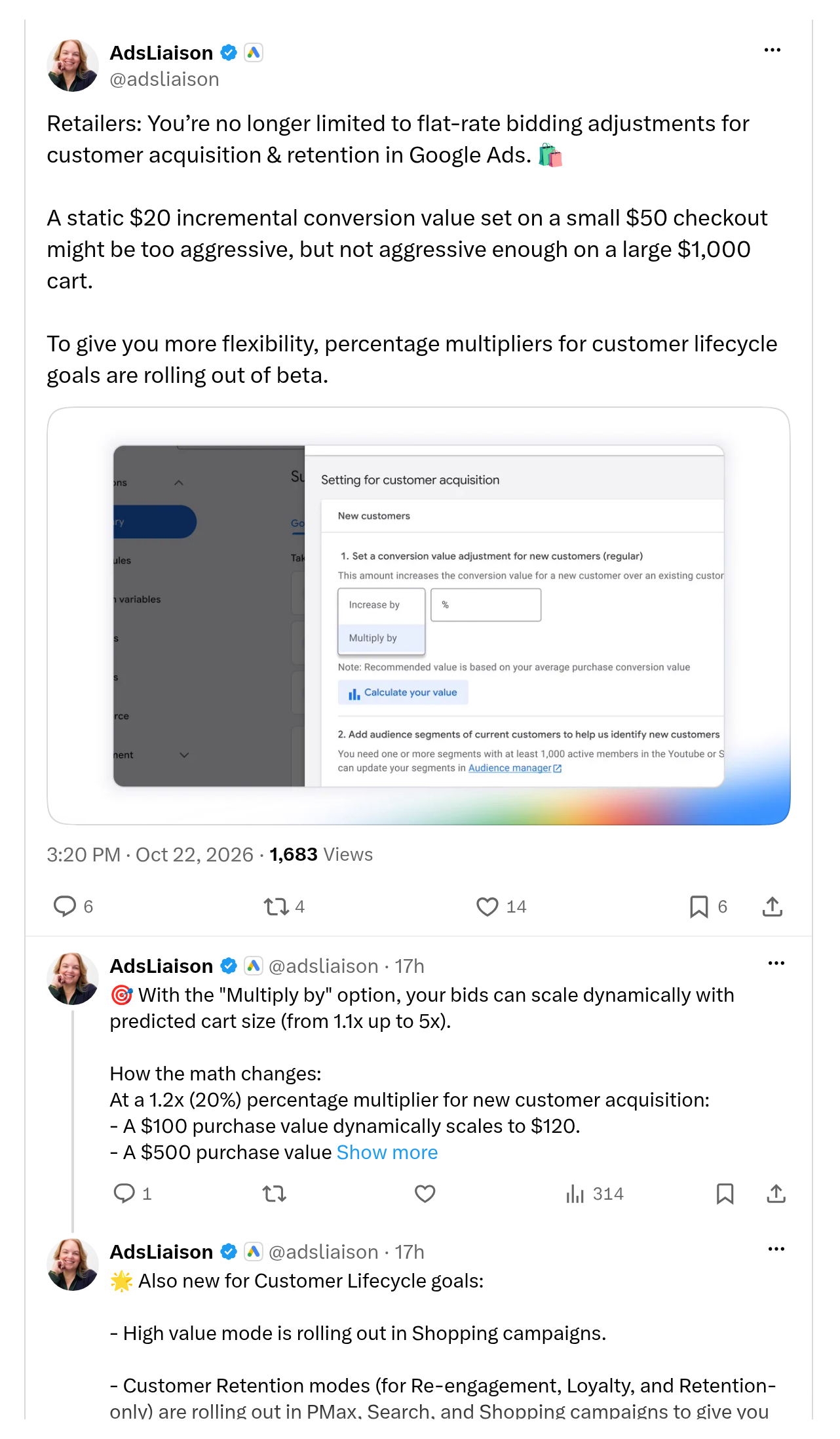
What a multiplier does, in plain terms
Google Ads bids harder for sales it thinks are worth more. A “new customer goal” tells it that a first-time buyer is worth extra.
- Flat bonus (the old way): every new customer’s order gets the same amount added, for example £20, whether they spend £30 or £600.
- Multiplier (the new option): the extra grows with the order. At 1.2x, a £100 first order counts as £120, and a £500 first order counts as £600.
That is fairer to shops that sell both cheap and expensive items. But at the top of the range, 5x, a £100 first order would count as £500 for bidding.
What Google did not say
PPC Land compared the thread with Search Engine Land’s report and flagged some gaps:
- Auction or report? The thread says bids scale with “predicted cart size”, but its example uses “purchase value”. It does not say whether the multiplier is applied at the auction, to the reported value, or both.
- Retention? The opening mentions acquisition “& retention”, but every example is about new customers.
- How the retention modes map to older betas. Google has not said.
Source: PPC Land — Google Ads lets retailers multiply new customer values up to 5x (22 October 2026).
Search Engine Land’s own warning is worth keeping: multipliers “don’t guarantee a particular bid increase, acquisition cost or campaign outcome.”
Source: Search Engine Land — Google Ads expands customer acquisition and retention controls (22 October 2026).
Why it matters for the P&L
- Your ROAS can look better without selling more. Google’s help page lists a separate column, “Original conv. value”, which “Displays the unadjusted value before any value rule adjustments, such as conversion value rules or lifecycle goals adjustments are applied.” If your team reports the normal conversion value, the bonus is likely in it. With a multiplier, that gap can be much bigger than a flat £20.
- Google may be guessing who is new. By default, Google treats someone as new if they have not bought in the last 540 days, using its own detection and your customer lists. The help page says that if you send your own new or returning flag in the conversion tag, “that parameter is used instead of Google auto-detection.” If you do not, a returning customer can be counted, and paid for, as new.
- Google Ads cannot prove the extra customers are extra. The help page says: “Incrementality testing of lifecycle goal settings isn't supported within Google Ads”. It points to Conversion Lift tests instead.
- Timing. This lands in the weeks before Black Friday. Changing how value is counted at the same time as peak spend makes it harder to read what worked.
Source: Google Ads Help — Measure your lifecycle goals campaigns (checked 23 October 2026).
This links to our earlier note on running a holdout before peak to see which sales Google Ads really earned. That post was about proving ads work at all. This one is about making sure the value they report is the value you banked.
Director checklist
- Find out if you use a new customer goal today. Ask your team or agency: which campaigns use it, is it a flat amount or a multiplier, and who chose the number?
- Add the real value to every report. Ask for the “Original conv. value” column next to “Conv. value” in Google Ads, and in any deck that shows ROAS.
- Tell Google who is new from your own data. Your order system knows if this is someone’s first order. Make sure the purchase tag sends that flag (
new_customerfor Google Ads conversions,customer_typefor GA4). On Shopify, Google says its Google & YouTube app sets this up automatically on an upgraded thank you page. - Check the customer lists. Google’s set-up screen asks for existing customer lists of at least 1,000 active members. Ask when your lists were last refreshed, and who signed off uploading them.
- Pick the multiplier from margin, not from a guess. A first order is worth more only if new customers come back. Use your repeat rate and margin to set the number, and write down why.
- Measure before and after. Google’s help page says lifecycle reports only start once the goal is switched on, and suggests a pre and post check using your own analytics. Record your new customer share for a few weeks before any change.
- Do not change it mid-peak. If you want to try a multiplier, test it on one campaign before Black Friday, or wait until January.
Questions to ask your team this week
- Which of our campaigns add extra value for new customers, and by how much?
- Does our ROAS slide show the original value or the adjusted value?
- Does our purchase tag tell Google if a buyer is new, or is Google guessing?
- How many “new” customers in Google Ads match first orders in our own system?
- What is our plan for the multiplier before and during peak?
Caveats
- Rollout is gradual. Google says “this month”. Your account may not show the option yet.
- Unknown details. Google has not said exactly where the multiplier is applied. Check the columns in your own account rather than assume.
- Reports are not retroactive. Lifecycle goal reporting only starts after the goal is switched on.
- Not legal advice. Uploading customer lists to Google needs a lawful basis under UK GDPR. Ask your DPO.
Final thoughts
#21/100 — A new customer bonus makes Google Ads look better on paper. Check the real sale value before it reaches the board.
Paying more to win a new customer can be a smart choice. Just make sure everyone knows which number is a target and which number is money in the bank.
Not sure what your Google Ads conversion values really include? Run our free GA4 and GTM tracking scan at https://audit.taggurus.co.uk/, email info@taggurus.co.uk, or book a meeting today to discuss.
FAQ
Q: What is a customer lifecycle goal?
A: A Google Ads setting that tells bidding to treat some customers as worth more. The new customer goal adds value for first-time buyers. Retention goals focus on lapsed or loyal customers.
Q: What exactly changed on 22 October?
A: Google said percentage multipliers, from 1.1x to 5x, are rolling out of beta this month across Search, Shopping, Performance Max and Demand Gen, in Google Ads and SA360. Before, the extra value could only be a fixed amount.
Q: Will this change the numbers in my Google Ads reports?
A: Google’s help page shows lifecycle goal adjustments sit on top of the original value, which is why a separate “Original conv. value” column exists. Compare the two columns in your account before you share ROAS.
Q: Does it change what GA4 shows?
A: The thread does not mention GA4. GA4 records the purchase value your site sends. So the gap between Google Ads conversion value and GA4 revenue can grow if a multiplier is on. Explain that gap before someone asks.
Q: How does Google know if a customer is new?
A: By default it uses its own detection (no purchase in 540 days) and your customer lists. If your conversion tag sends a new or returning flag, Google uses that instead.
Q: Should we switch it on?
A: It can make sense if your catalogue has a wide price range and new customers come back. Decide the number from your margin and repeat rate, test it on one campaign, and judge it on your own orders.
Sources
- https://x.com/adsliaison/status/2113274186785255772 (AdsLiaison on X, Google’s ads product liaison account, three-post thread, 22 October 2026, 3:20pm UK time, checked 23 October 2026: “Retailers: You’re no longer limited to flat-rate bidding adjustments for customer acquisition & retention in Google Ads”; “A static $20 incremental conversion value set on a small $50 checkout might be too aggressive, but not aggressive enough on a large $1,000 cart”; “percentage multipliers for customer lifecycle goals are rolling out of beta”; “from 1.1x up to 5x”; “rolling out globally this month across Search, Shopping, Performance Max, and Demand Gen in both Google Ads and SA360”; high value mode in Shopping; Re-engagement, Loyalty and Retention-only modes in PMax, Search and Shopping)
- https://support.google.com/google-ads/answer/15597581?hl=en (Google Ads Help, “Measure your lifecycle goals campaigns”, checked 23 October 2026: “Original conv. value” definition; 540-day auto-detection; new vs existing customer parameter “used instead of Google auto-detection”; “Incrementality testing of lifecycle goal settings isn't supported within Google Ads”; reporting “only provided post lifecycle goal activation”)
- https://support.google.com/google-ads/answer/12077475?hl=en (Google Ads Help, “Set up new customer acquisition parameter in your conversion tracking tag”, checked 23 October 2026:
new_customerfor Google Ads conversion tags,customer_typefor Google Analytics; Shopify Google & YouTube app sets it automatically on an upgraded thank you page) - https://ppc.land/google-ads-lets-retailers-multiply-new-customer-values-up-to-5x/ (PPC Land, 22 October 2026: thread does not say whether the multiplier applies at the auction, to the reported value, or both; segments of at least 1,000 active members shown in Google’s interface; Original Conversion Value metric added November 2025)
- https://searchengineland.com/google-ads-expands-customer-acquisition-and-retention-controls-497820 (Search Engine Land, Anu Adegbola, 22 October 2026: retention mode descriptions; multipliers “don’t guarantee a particular bid increase, acquisition cost or campaign outcome”)
